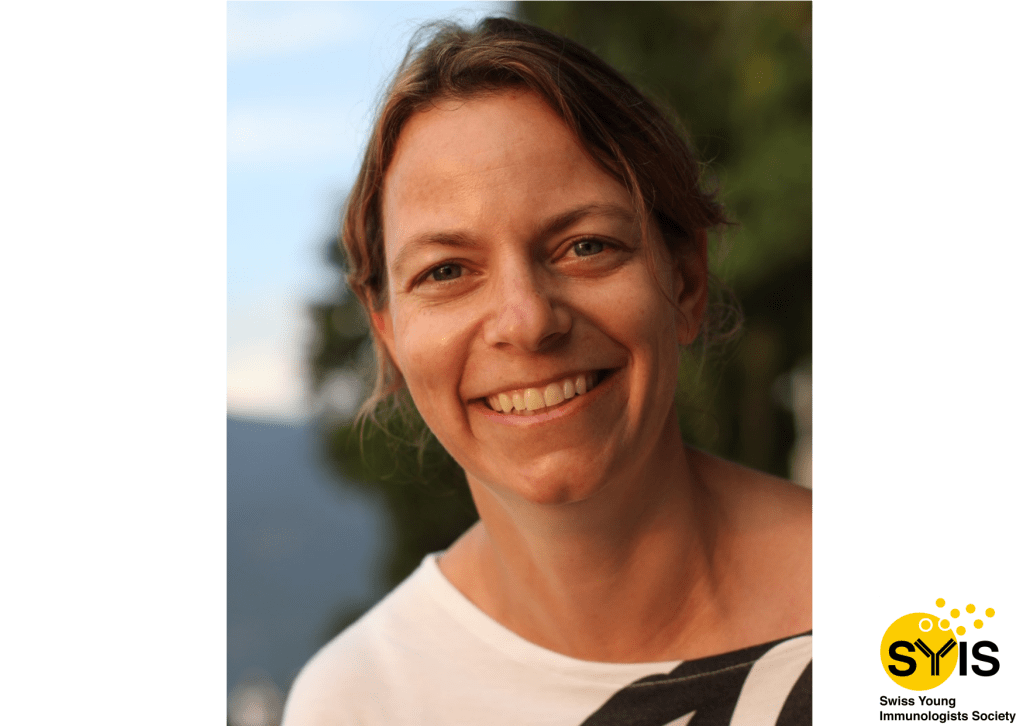
Nicole Joller is a Professor of Immunology at the University of Zurich and her research group focuses on understanding immune system regulation in host-pathogen interactions and studying the influence of infection history on disease susceptibility. After completing her PhD at ETH Zurich and post-doctoral studies at Harvard Medical School, she founded her research group at the University of Zurich where she was awarded an SNSF Professorship in 2014 and an ERC Starting Grant in 2016. Since 2022, she has been a Professor of Immunology at the Department for Quantitative Biomedicine at UZH.
University of Zurich – Department of Quantitative Medicine – Nicole Joller
- Why did you choose to become a scientist?
I’ve always been curious and wanted to understand how things work. In my eyes, there’s no other profession where I’d be able to follow this curiosity as closely and constantly experience the excitement of being able to piece things together.
- What passionates you the most about immunology? How did you choose this field of study?
I was introduced to immunological research during my Master thesis working in a fantastic group of outstanding and very supportive scientists that got me truly hooked on the topic. The immune system influences so many aspects of our body and plays some kind of role in almost all diseases. Its complexity allows it to be extremely versatile and adapt to changing challenges, which I find amazing. On the flip side, this broad impact of the immune system also requires potent regulation to ensure appropriate immune responses. I’m fascinated by the interactions of the different components of the immune system and how this ultimately changes the outcome of an immune response.
- What kind of prejudices, if any, did you have to face as a woman scientist? What helped you to overcome them?
There have been a few occasions where I have seen prejudices at play, which at times required an extra push from my side but none of them really had an impact on me or my career.
One aspect where I do see a difference is in regard to administrative tasks as every representative body or committee aims to have female representatives. It is great, that women are represented in all the important groups but as they are underrepresented in leading positions, women (myself included) end up investing more time into these tasks than their male colleagues. While this is additional work, it can also work in our favor, in my case increasing my visibility and allowing me to take up interesting task, when my male colleagues at a similar career stage would not get that opportunity.
When it comes to hurdles that I faced during my career, I have always had both female and male mentors and colleagues that supported me and helped me overcome obstacles, whenever I had to face them.
- What advice would you give to your younger self at the start of your career?
Pursue the science that you’re passionate about, gain experience in different groups and countries and cherish exchange with other scientists from your own but also from other fields. All of these aspects have been very important for my career.
At times it would have helped to be more patient and have a bit of buffer time to fully complete projects rather than pushing forward and moving on to the next but unfortunately patience really isn’t my strength, so I’m not sure I would have listened…
- Did you ever doubt your abilities as a scientist? If so, how did you handle these feelings?
There have of course been times when I was stuck in a project and could not understand why things weren’t working or what I had missed. I think that in these situations, questioning your approach and interpretation is a part of a healthy self-reflection and an important step towards realizing when to seek advice and support from peers.
- What do you consider your biggest achievement so far?
Having trained a number of excellent scientists.
- What was your first impression of Switzerland when you visited it the first time and what do you think about it now?
I grew up in Switzerland, so my view is biased.
Switzerland has an excellent education system and the students that we see in the lab are very well educated and trained. Innovation, science and education are generally highly valued by the Swiss society and thus there is sufficient funding to enable high quality research. I consider myself very lucky that after my postdoc in the US I was able to move back to my home country and pursue an academic career here.
- If you had to switch careers, what other field (scientific or not) would you see yourself working in and why?
Luckily, I didn’t have to come up with a plan B so I don’t really have an answer to this.
- Beside your scientific interests, what are your personal interests?
Traveling, good food and wine and most importantly my family.
- What advice would you give to young women who want to pursue the same career as you?
Follow your passion, find mentors and colleagues that support you and choose a partner that supports you along this path.
 SYIS
SYIS 
Leave a comment